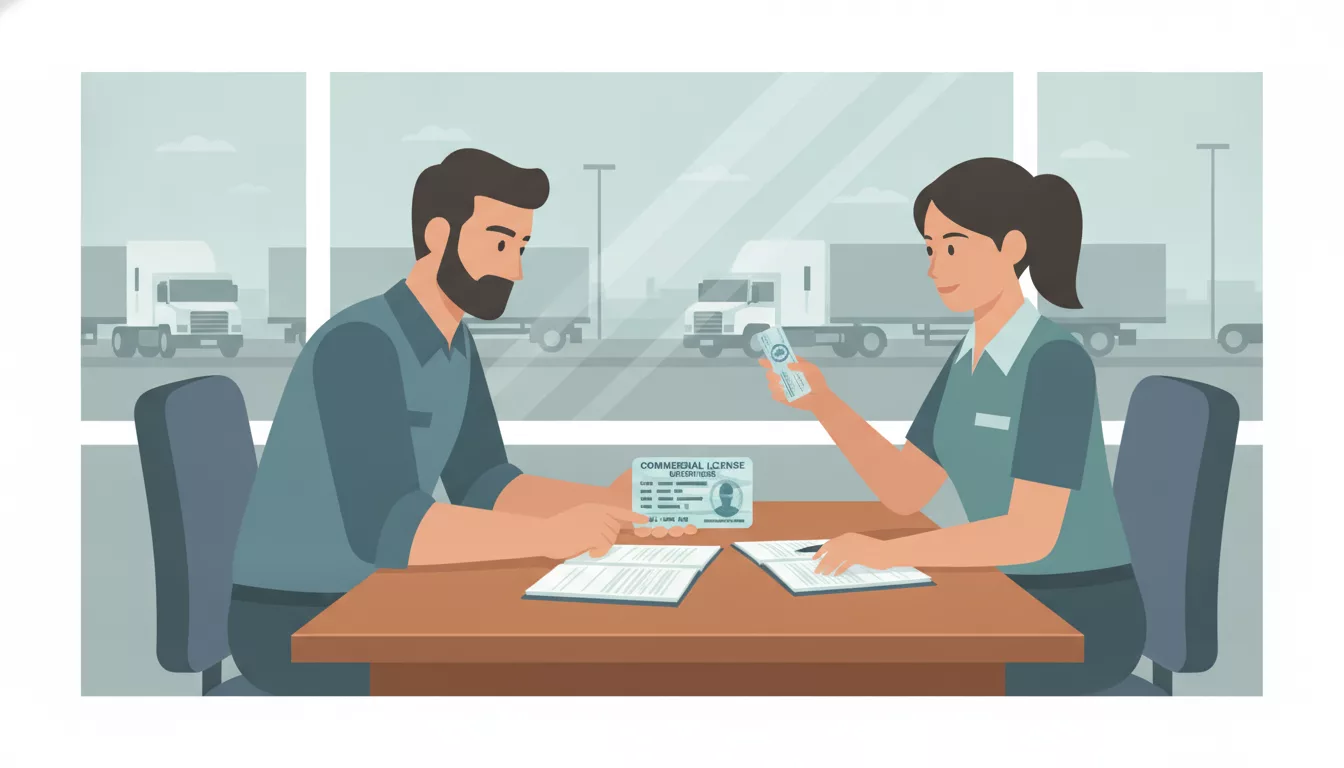
A truck driver interview doesn't look like most job interviews. There's no whiteboard test, no case study, no "tell me about a time you showed leadership." The recruiter or safety manager across the table wants to know one thing above everything else: can this person be trusted alone with an 80,000-pound vehicle, a tight delivery window, and nobody watching. Everything they ask is really a version of that question.
That works in your favor if you've actually driven. Trucking hiring is practical, not theoretical. If you can talk clearly about your driving record, your hours-of-service habits, and how you handle a bad situation on the road, you're already ahead of candidates who show up with a clean shirt and nothing else. This guide covers the real questions asked at company fleets, regional carriers, and owner-operator interviews in 2026 - along with the paperwork checks that happen before you ever sit down. For pay context going in, our truck driver salary guide breaks down what drivers actually earn by route type and experience. If you're brand new to interviews in general, start with our complete interview preparation guide.
What Happens Before You Ever Meet a Person
Trucking hiring runs through more background checks than almost any other industry, and most of them happen before the interview is even scheduled. Knowing what a carrier is going to find matters more here than in a typical job search, because there's no bluffing your way past a database.
The PSP Report
The Pre-Employment Screening Program report pulls your last five years of crash history and three years of roadside inspection results directly from FMCSA records. Recruiters pull this before they call you. If you have inspections on file, know what they were for - a minor equipment violation reads very differently than a hours-of-service falsification. Don't wait to be asked. If your PSP has something on it, bring it up yourself and explain what changed since then.
The Drug and Alcohol Clearinghouse
Since 2020, every carrier is legally required to query the FMCSA Clearinghouse before hiring a CDL holder, and again every year you're employed. It shows any drug or alcohol violation across every carrier you've worked for - a positive test, a refusal to test, anything. There is no way around this database and no way to hide a violation from a new employer. If you have one, you need to have already completed the Return-to-Duty process with a Substance Abuse Professional before you're even eligible to be hired for a CDL position. Be upfront about where you are in that process if it applies to you.
MVR and Employment Verification
Your Motor Vehicle Record gets pulled in every state you've held a license, and carriers are required to verify your last three years of employment history under DOT rules (ten years if you'll be hauling hazmat or interstate). Gaps in that history get questioned directly - have an honest, specific answer ready if you took time off, whether it was for a DOT-related reason, a family situation, or something else.
Entry-Level and New CDL Holder Questions
If you just finished CDL school, the interviewer knows you don't have road experience yet. They're evaluating whether you actually learned the material or just passed the test.
"Walk me through a full pre-trip inspection."
This is the single most common question asked of new drivers, and some carriers will actually walk you out to a truck and have you do it. Know the sequence cold: engine compartment (fluids, belts, hoses, leaks), cab check (gauges, mirrors, horn, wipers, seatbelt), walking the exterior (lights, tires, tread depth, wheel seals, mud flaps), coupling system if you're driving a combination vehicle (fifth wheel, kingpin, air and electrical lines), and the brake check (low air warning, spring brake pop-out, and the tug test after building air pressure). If you fumble the order, that's fine as long as you don't skip components. Skipping components is what fails you.
"What CDL school did you attend, and how many hours of behind-the-wheel time did you get?"
Be specific. Name the school, whether it was company-sponsored or independent, and give an honest number of hours - both range and city driving, plus backing practice. If your training was light on backing (a common complaint about fast, low-cost CDL mills), say so and mention you're aware backing is your weak spot and are working on it. Recruiters respect self-awareness far more than a driver who claims to be great at everything three weeks out of school.
"Are you comfortable with a manual transmission, or only automatic?"
Manual transmissions are becoming less common in newer fleets, but plenty of trucks - especially older company trucks and most owner-operator rigs - are still ten-speed manuals. If your CDL school only trained you on automatic, say that plainly. Some carriers will still hire you and put you through a short manual add-on; others require it upfront. Either way, don't guess at an answer you're not sure about, because it gets tested on your first day.
Experienced Driver Questions
If you're an experienced CDL holder moving between carriers, the questions shift from "can you drive" to "why are you leaving, and what kind of driver are you."
"Why are you leaving your current company?"
Trucking has real turnover, and recruiters have heard every excuse. Avoid trashing your last carrier even if you have legitimate complaints - "the dispatcher was unfair" reads as a red flag regardless of whether it's true. Frame it around what you're looking for instead: more home time, better freight lanes, newer equipment, a switch from OTR to regional so you can see your family more, or a pay structure that rewards the miles you actually run. If safety issues were the real reason (a carrier pushing you past hours, ignoring maintenance requests), it's fine to say that factually and without venting.
"What's your average weekly mileage, and what lanes have you run?"
Have real numbers ready. Carriers use this to gauge both your experience level and whether your driving style fits their freight - a driver used to 3,000 OTR miles a week is a different fit for regional dedicated routes than someone who's only run local drayage. Name specific lanes or regions if you can (I-80 corridor, Southeast reefer freight, Northeast dedicated) rather than a vague "all over."
"Have you ever had a preventable accident? Walk me through it."
If you have one, don't minimize it and don't over-explain it into a different story than what's on your record. State what happened, what the root cause was, and specifically what you changed afterward - following distance, mirror checks, fatigue management, whatever applies. Carriers are less worried about the fact that something happened once than they are about whether you learned anything from it. A driver with one incident from five years ago who can talk clearly about the lesson usually interviews better than one who claims a spotless record that doesn't match their PSP.
Hours of Service and ELD Questions
Every carrier will probe your understanding of hours-of-service rules, because HOS violations are one of the fastest ways a driver gets a company put out of service.
"Explain the 11-hour and 14-hour rules in your own words."
You get 11 hours of actual drive time within a 14-hour on-duty window, following 10 consecutive hours off duty. The 14-hour clock keeps running whether you're driving, loading, or stuck at a shipper - it doesn't pause for breaks the way the drive clock effectively does with the 30-minute break rule. Know the 60/70-hour rule too (60 hours in 7 days or 70 in 8, depending on the carrier's operation), and how the 34-hour restart works to reset it. If you're rusty on the exact numbers, review them before the interview - guessing wrong here signals you might run outside your legal hours without realizing it.
"What ELD have you used, and have you ever had a hard time getting a load in before your clock ran out?"
Name the system if you know it (KeepTruckin/Motive, Samsara, Omnitracs, PeopleNet). The second half of the question is really asking whether you'll run illegal when a dispatcher pushes you. The right answer is that you communicate early with dispatch when a delivery is going to run you close to your hours, and you stop and log off-duty rather than falsify a log or push through fatigued. Carriers that ask this directly are usually trying to weed out drivers who'll cut corners under pressure - say the honest thing, not the thing you think they want to hear, because an experienced safety manager can tell the difference.
Endorsement and Equipment-Specific Questions
If the position requires hazmat, tanker, or doubles/triples endorsements, expect targeted questions about them.
Hazmat
Beyond having the endorsement itself (which requires a TSA background check), expect questions about placarding requirements, segregation rules for incompatible materials, and what you do in the event of a spill or leak en route. Know your emergency response guidebook basics even if you haven't needed them yet.
Tanker
Liquid surge is the big one - how driving technique changes with a partially full tank versus a full one, and how you adjust speed into curves and during braking to manage it. If you've hauled fuel, chemicals, or food-grade liquids, mention which, since food-grade tanker work has its own wash-out and certification requirements that carriers like to hear you already understand.
Flatbed and Securement
Flatbed-specific interviews often ask about load securement math - working load limit, the aggregate working load limit rule requiring your tie-downs to total at least half the cargo weight, and how you tarp different freight types. If you've never run flatbed and are applying for it fresh, say so directly; most flatbed carriers expect to train securement regardless and would rather know upfront than have you guess your way through a DOT inspection.
Owner-Operator and Lease-Purchase Questions
If you're interviewing to lease on with a carrier as an owner-operator rather than as a company driver, the conversation shifts toward business basics, not just driving skill.
Expect questions about your understanding of the settlement structure (percentage of load versus mileage pay), what's deducted before you see a check (fuel, insurance, truck payment, ELD fees, trailer rental if applicable), and whether you understand the difference between gross revenue and what actually lands in your pocket. Carriers that recruit owner-operators heavily sometimes gloss over the real economics in the pitch - a driver who asks sharp, specific questions back about deductions and minimum load guarantees usually gets taken more seriously, not less. If you're evaluating a lease-purchase deal specifically, ask to see a sample settlement from a current driver before you sign anything, and read the lease agreement's early termination penalty before you commit.
Questions to Ask the Recruiter
A good question or two shows you're evaluating the carrier as seriously as they're evaluating you - and in a driver's market, you should be.
- "What's your driver turnover rate, and what's the biggest reason drivers leave?" - A recruiter who deflects this or claims turnover is a non-issue is usually hiding something. High turnover in trucking is common, but a carrier that can't or won't give you a number is a bigger warning sign than a high number they explain honestly.
- "What does a typical week look like for this specific route or freight type?" - Get specifics on home time, average length of haul, and whether you'll be drop-and-hook or live-load/live-unload, since detention time at shippers eats into both your hours and your pay if you're on a per-mile rate.
- "How is detention pay handled, and after how long does it kick in?" - Sitting at a dock unpaid is one of the most common driver complaints. Know the policy before you take the job, not after your first three-hour wait at a warehouse.
- "What's the average age of the equipment I'd be driving?" - Older trucks break down more, and breakdowns cost you both money and home time. A carrier proud of its equipment will usually tell you the average age unprompted.
- "Is there a mentor or trainer period, and how is it paid?" - Especially relevant for newer drivers. Training pay is often lower than standard pay, and you want to know exactly how long that period lasts before your rate goes up.
After the Interview
Trucking hiring moves fast when there's freight to cover, sometimes offering a start date within days of the interview. Don't skip a short thank-you message anyway - a brief thank-you email to the recruiter confirming your interest and start-date availability keeps you at the top of the pile if the carrier is deciding between a couple of candidates.
If the process includes a road test or ride-along evaluation, treat it as seriously as the sit-down interview - it's often the deciding factor, especially for company fleets that had a bad experience with a driver who talked well but drove poorly. Do a clean pre-trip, drive within posted limits, and don't rush backing maneuvers just because someone's watching.
Trucking rewards drivers who are honest about their record, clear about their hours, and serious about safety over drivers who talk a good game. The recruiter across the table has heard every version of "I'm a great driver" - what actually gets you hired is specific, verifiable detail about how you handle the job day to day. If that's you, the interview is just confirming what your record already shows.