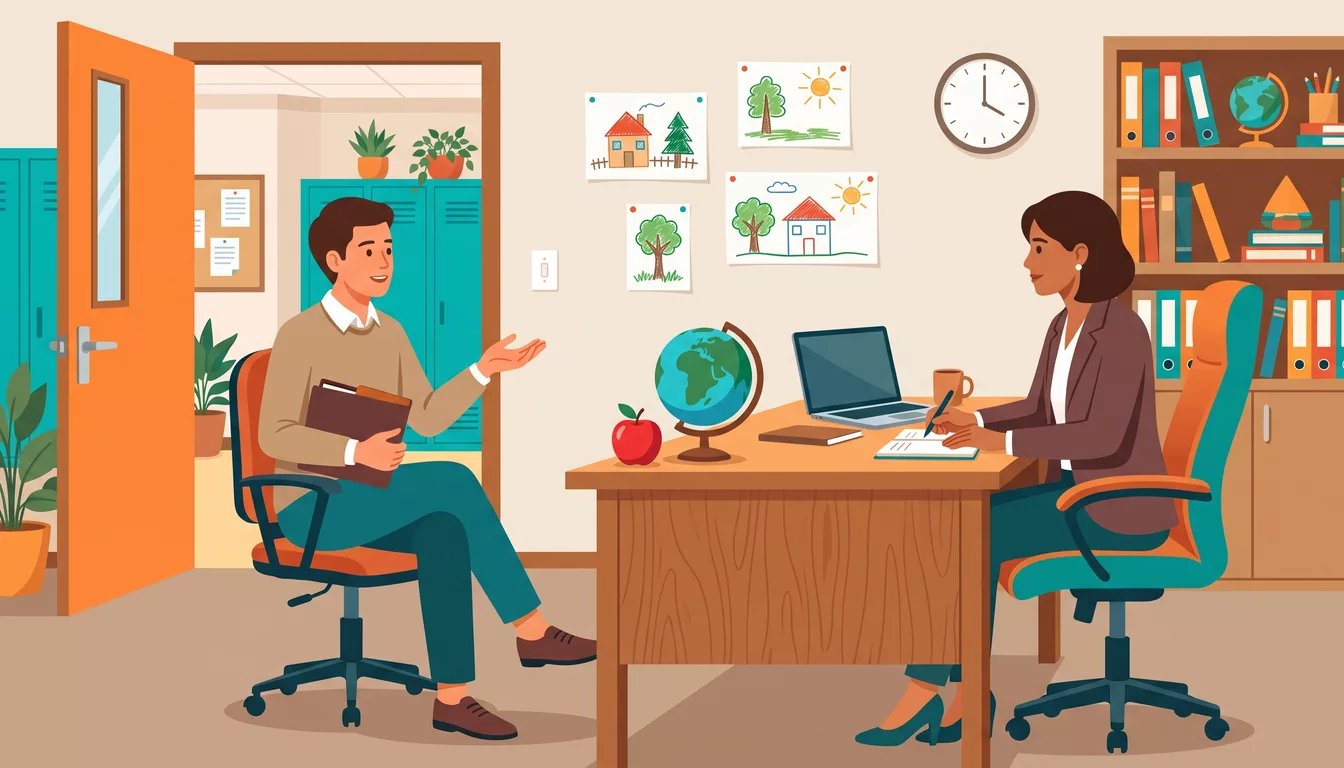
Teacher interviews feel different from other job interviews because they are different. (Make sure your teaching cover letter is equally strong.) You're not just answering questions about your qualifications - you're proving you can connect with kids, manage a room of 25+ personalities, explain things clearly, and handle parents who think their child can do no wrong. All in about 45 minutes.
Principals have seen hundreds of candidates walk through their doors. They know who's rehearsed generic answers from the internet and who actually understands what the job looks like on a Tuesday in February. (Know what teachers actually earn before you walk in.) when half your class has the flu and you're behind on your curriculum map. This guide covers the real questions you'll face, with strategies that work whether you're a brand-new graduate or a veteran switching districts.
What the Teacher Interview Process Actually Looks Like
Teaching interviews don't follow a single format. The process varies wildly depending on the district, school type, and grade level. (If your interview is virtual, check our virtual interview tips.) But here's what you'll typically encounter:
Public schools usually run panel interviews. You'll sit across from 3-5 people - the principal, an assistant principal, a department head or grade-level lead, and sometimes a teacher from the team you'd be joining. The panel asks predetermined questions (they have to, for legal and equity reasons), and each panelist scores your responses independently. The whole thing takes 30-45 minutes.
Private and charter schools tend to be less formal. You might interview one-on-one with the head of school, then meet with a few teachers over coffee. The questions are less scripted, and the vibe is more conversational. They're looking for cultural fit as much as teaching ability.
Demo lessons are increasingly common, especially for elementary positions and competitive districts. You'll teach a 15-20 minute lesson to a group of students (or sometimes to the interview panel pretending to be students, which is awkward but you roll with it). More on this later.
Some districts add extra steps: a writing prompt, a group activity with other candidates, or a second-round interview with the superintendent. But the core of almost every teaching interview is the sit-down Q&A, and that's what we'll focus on first.
The Questions Every Teaching Candidate Gets Asked
These are the bread-and-butter questions. You will hear some version of every single one of these, regardless of grade level or subject area.
"Tell us [about yourself](/resources/interview/tell-me-about-yourself)."
This is your opening pitch, and most candidates blow it by reciting their resume. The panel already has your resume. They want to know who you are as a person and why you ended up in education.
Keep it to 90 seconds. Hit three things: what drew you to teaching, a quick snapshot of your experience (or student teaching, if you're new), and what excites you about this specific school or role. That last part matters more than you think - it shows you did your homework.
What works: "I became a teacher because my 7th-grade science teacher, Mr. Orozco, made me feel like I was smart for the first time. I've spent the last four years teaching 6th-grade science at Madison Middle School, where I built a hands-on lab program from scratch. I'm excited about this position because your school's STEM focus aligns with exactly the kind of teaching I want to do more of."
What doesn't: "Well, I graduated from State University in 2020 with a degree in education, and then I got my first job at..."
"Why do you want to teach at this school?"
Principals can tell immediately when you're giving a generic answer. Before your interview, spend 30 minutes on the school's website. Read their mission statement. Look at their test scores on your state's report card site. Check if they've won any awards or been in the news recently. Follow their social media.
Then connect something specific about the school to something specific about you. "I noticed your school uses project-based learning across all grade levels, and that's exactly how I structured my units at my last school" is a thousand times better than "I've heard great things about your school community."
"What is your teaching philosophy?"
This question makes people freeze because it sounds so big and abstract. Don't overthink it. Your teaching philosophy is really just the answer to: "What do you believe about how kids learn best, and how does that show up in your classroom?"
The strongest answers are specific and personal. Talk about what you've actually seen work. If you believe in hands-on learning, describe what that looks like in your room. If you're big on building relationships first, explain how you do that during the first week of school.
What works: "I believe every student can learn, but not every student learns the same way or at the same pace. In my classroom, that means I build in multiple entry points for every lesson. When I taught fractions last year, some students used manipulatives, some worked with visual models, and some went straight to abstract problems. The goal was the same - the path was different. And I check for understanding constantly, not just at the end of the unit when it's too late to reteach."
"How do you handle classroom management?"
This is the single most important question in any teaching interview. Principals lose sleep over classroom management because a teacher who can't manage behavior will generate parent complaints, disrupt other classrooms, and drain admin time. They need to know you can handle it.
The key word here is proactive. Every strong answer emphasizes prevention over punishment. Talk about the systems you put in place before problems start: clear expectations taught and practiced in the first two weeks, consistent routines, strong relationships, and engaging lessons that don't give kids time to act out.
Then acknowledge that even the best systems don't prevent everything. Describe how you handle disruptions when they happen - proximity, redirection, private conversations, logical consequences. Show that you have a toolbox, not just one approach.
What works: "My management approach starts with relationships. I greet every student at the door by name every single day. I learn what they're into - their sports teams, their video games, their favorite music. When a student knows you genuinely care about them, they're much less likely to test your boundaries. On the systems side, I co-create classroom expectations with students during the first week. They help write the rules, so they have ownership. I use a lot of positive reinforcement - I aim for a 5-to-1 ratio of positive to corrective interactions. When I do need to redirect, I keep it private and respectful. A quick conversation in the hallway is way more effective than calling a kid out in front of their peers."
Red flag answer: "I'm pretty strict. If a student acts up, they go to the office." (This tells the principal you'll be sending kids to them constantly.)
"How do you differentiate instruction?"
Differentiation comes up in nearly every teaching interview because classrooms are more diverse than ever. You'll have gifted students, students with IEPs, English language learners, and students who are three grade levels behind - all in the same room. Principals want to know you can reach all of them.
Don't just say "I differentiate by content, process, and product" like you're quoting a textbook. Give a real example. Describe a specific lesson where you modified the task, the materials, the level of support, or the output to meet different learners.
What works: "In my 4th-grade reading groups, I ran literature circles at three different text levels. All groups discussed the same themes - character motivation, conflict resolution - but the texts themselves ranged from a 2nd-grade to a 5th-grade reading level. My students with IEPs had graphic organizers and sentence starters to scaffold their written responses. My advanced readers had extension questions that pushed them into analysis. The goal was the same standard, but each student accessed it at their level."
"Tell us about a time you worked with a difficult parent."
Every teacher has a parent story. The key is showing you can handle conflict professionally without throwing the parent under the bus. Even in the interview, badmouthing parents (or former colleagues, or past principals) is a dealbreaker.
Use the STAR structure loosely: describe the situation briefly, explain what you did, and share the outcome. Emphasize listening, empathy, and finding common ground. The underlying message should be: "I understand that parents are advocating for their child, and I can work with that."
What works: "I had a parent who was upset about her son's grade on a writing assignment. She emailed me saying the grade was unfair and she wanted a meeting. I called her that afternoon - I find phone calls de-escalate things faster than email - and started by listening to her concerns. She felt her son had worked hard and deserved more credit. I walked her through the rubric and showed her specific areas where his essay didn't meet the criteria, but I also pointed out what he did well. Then I offered a revision opportunity so he could improve his grade. She was completely on board. By the end of the year, she was one of my biggest supporters."
Questions About Curriculum and Instruction
These dig deeper into how you actually teach. Expect 2-3 of these depending on the position.
"Describe a lesson you taught that went really well. Why did it work?"
Pick a lesson you're genuinely proud of. Be specific about what you did, why students were engaged, and what evidence you have that they actually learned something. "They seemed to enjoy it" isn't evidence. "Exit ticket data showed 85% of students mastered the objective" is.
"How do you use data to inform your instruction?"
This is huge right now. Principals want to hear that you're not just teaching and hoping for the best. Talk about the assessments you use (formative and summative), how you analyze the results, and what you do with what you find. Maybe you noticed 60% of your class bombed a specific standard, so you retaught it using a different approach. That's the kind of answer they want.
For new teachers: you can talk about how you used assessment data during student teaching, or how you would set up a data tracking system in your first year.
"What technology do you use in the classroom?"
Don't just list apps. Talk about how technology enhances learning - not just makes it flashier. There's a difference between "I use Kahoot for review games" and "I use Kahoot strategically before assessments because the data tells me exactly which concepts students are still struggling with, and I can reteach before the test."
Good tools to mention (with purpose): Google Classroom for organization, Nearpod or Pear Deck for interactive lessons, formative assessment tools like Kahoot or Quizizz for real-time data, and any subject-specific platforms you've used (Desmos for math, CommonLit for ELA, PhET for science).
"How do you handle students who are significantly below grade level?"
This question is really about whether you'll give up on struggling students or whether you'll fight for them. Talk about diagnostic assessments to identify gaps, targeted small-group instruction, scaffolding, and collaboration with intervention specialists. But also be realistic - acknowledge that you can't do it alone, and that you work with the school's support systems (reading specialists, math interventionists, special education team).
Behavioral and Scenario Questions
These are the "what would you do if..." questions. Principals love them because they reveal your instincts.
"A student refuses to do the work. What do you do?"
The wrong answer is to immediately escalate to consequences. The right approach is to get curious. Why is the student refusing? Are they confused? Overwhelmed? Dealing with something at home? Having a bad day?
Strong answer: "First, I'd check in privately. I'd kneel down next to their desk and quietly ask if everything's okay. Sometimes the work is too hard and they'd rather look defiant than ask for help. Sometimes something happened at lunch. If it's an academic issue, I can modify the task on the spot. If it's emotional, I might give them a few minutes to reset. If it becomes a pattern, I'd want to have a deeper conversation and possibly involve the counselor. What I wouldn't do is make it a power struggle in front of the whole class."
"You discover two students are bullying a classmate. How do you handle it?"
This tests your judgment, your knowledge of school policy, and your ability to protect students. The right answer involves multiple steps: address the immediate situation, comfort the victim, report to administration (this is non-negotiable in most districts), document what happened, and follow up with all students involved. Don't try to handle serious bullying entirely on your own.
"A parent shows up at your classroom door, angry about something that happened in class. What do you do?"
This happens more than people realize. The correct approach: stay calm, don't have the conversation in the hallway, and don't have it in front of students. Invite the parent to schedule a meeting at a time when you can give them your full attention. If they're extremely upset, involve your administrator. Never argue with a parent in the doorway of your classroom.
"You disagree with a new school policy or curriculum decision. What do you do?"
Principals want team players, but they also respect teachers who think critically. The best answer shows you'd voice your concerns through appropriate channels (department meetings, conversations with admin) while still implementing the policy professionally. "I might disagree privately, but publicly I'm part of the team" is the right vibe.
New Teacher vs. Experienced Teacher: How the Interview Shifts
The questions are mostly the same, but what the panel is listening for is completely different.
If You're a New Teacher (0-2 Years or Student Teaching Only)
Principals know you don't have a track record yet. They're looking for:
- Coachability - Are you open to feedback? Will you take direction from a mentor teacher?
- Energy and enthusiasm - New teachers who are excited about the work stand out. Not fake excitement. Real "I've been wanting to do this for years" energy.
- Student teaching stories - Your student teaching experience is your experience. Treat it that way. Talk about lessons you planned, students you reached, challenges you overcame.
- Self-awareness - You're not expected to have it all figured out. Saying "Classroom management is the area I want to grow in most, and here's my plan for that" is way better than pretending you've already mastered everything. (Need help framing a weakness? See how to answer the greatest weakness question.)
A principal once told me: "I'd rather hire a first-year teacher who's honest about what they don't know than a fifth-year teacher who thinks they know everything."
If You're an Experienced Teacher (3+ Years)
You're expected to bring evidence. Not opinions about teaching - proof that your approach works.
- Data and outcomes - "My students' reading levels grew an average of 1.5 grade levels over the year" is the kind of thing that makes panelists sit up.
- Leadership experience - Have you mentored new teachers? Led professional development? Served on committees? These show you're more than just a classroom teacher.
- Reflection and growth - What have you changed about your teaching over the years, and why? This shows you're not just doing the same thing year after year.
- Why you're leaving your current school - Be honest but diplomatic. "I'm looking for a school that aligns more closely with my teaching philosophy" works. "My principal was terrible" does not.
The Demo Lesson: How to Crush It
More schools are requiring demo lessons, and for good reason - it's the closest thing to seeing you actually teach. Here's how to prepare.
Before the Lesson
Ask the school what you'll be teaching. (Here's how to prepare for any interview step by step.) Most will tell you the grade level, subject, and either a specific topic or let you choose. If you get to choose, pick something you've taught successfully before. This is not the time to experiment with a brand-new lesson.
Find out the logistics: How many students? How long? Is there a projector? A whiteboard? Will you have access to the room beforehand? Ask all of these questions. It shows you think ahead.
Bring printed copies of your lesson plan for the panelists. Even if they don't ask for it, having a clean lesson plan with your objective, materials, and assessment strategy makes you look organized.
During the Lesson
Structure matters. Use the "I Do, We Do, You Do" framework:
- Hook (2-3 minutes) - Start with something that grabs attention. A question, a quick story, a surprising fact. Not a 5-minute PowerPoint about yourself.
- Direct instruction (5-7 minutes) - Model the skill or concept clearly. Think aloud so the panel can see your thought process.
- Guided practice (5-7 minutes) - Have students try it with your support. Walk around, check in, ask questions.
- Independent practice or closing (3-5 minutes) - Let students work on their own, then close with a check for understanding (exit ticket, quick share-out, thumbs up/down).
Three things that impress panelists every time: calling students by name (ask for name tags or a seating chart), adjusting on the fly when something isn't working, and genuine warmth with the students. Kids can tell when an adult is comfortable with them, and so can the people watching.
Common Demo Lesson Mistakes
- Talking the entire time without letting students participate
- Trying to cram a 45-minute lesson into 15 minutes
- Reading from your notes instead of engaging with students
- Ignoring raised hands or struggling students
- Over-relying on technology (what if the projector doesn't work?)
What to Bring to the Interview
Pack these the night before so you're not scrambling in the morning:
- Copies of your resume (5-6, one for each panelist and a spare)
- A teaching portfolio - This can be a simple binder with: your teaching philosophy (one page), 2-3 sample lesson plans, photos of your classroom or student work, letters of recommendation, and any data showing student growth. Don't make it 50 pages. Keep it focused.
- References list with current contact information
- Copies of certifications and transcripts if they asked for them
- Questions for the panel written down (more on this below)
- A pen - you'd be surprised how many candidates don't bring one
Questions You Should Ask Them
At the end of every interview, you'll hear: "Do you have any questions for us?" Saying "no" is a missed opportunity. (Here are more questions to ask your interviewer.) Good questions show you're thoughtful about where you work - not just desperate for any job.
Strong questions:
- "What does the mentoring or onboarding process look like for new teachers here?" (Shows you value growth and support.)
- "How does the grade-level/department team collaborate?" (Shows you're a team player.)
- "What are the biggest challenges your students face?" (Shows you care about the actual kids, not just the job.)
- "What does professional development look like at this school?" (Shows you want to keep learning.)
- "What qualities have made teachers really successful at this school?" (This one is gold - it tells you exactly what they value.)
Questions to avoid:
- "What's the salary?" (This should come from HR, not the interview panel.)
- "How strict is the attendance policy for teachers?" (Raises red flags.)
- "Do I have to attend after-school events?" (Makes you seem checked out.)
- Anything you could have found on the school website in 30 seconds
Red Flags to Watch For (From Their Side and Yours)
Red Flags That Hurt Your Candidacy
- Badmouthing your current or former school - Even if your last principal was genuinely awful, keep it professional. Principals talk to each other. A lot.
- Being vague about classroom management - If you can't articulate how you handle behavior, principals assume you can't handle it.
- Not knowing anything about the school - Walking in without having looked at the website signals you'll take any job, not that you want this one.
- Only talking about content, never about students - "I love teaching math" is fine, but "I love watching kids have that lightbulb moment when fractions finally click" is what makes principals excited to hire you.
- Arriving late or looking sloppy - First impressions are real. Dress business professional. 15 minutes early. End of story.
Red Flags From the School
You're interviewing them too. Watch for:
- "We're like a family here" - This often means they expect you to work nights, weekends, and summers without extra pay. Boundaries might be non-existent.
- High turnover they can't explain - Ask how long teachers typically stay. If they dodge the question, that's your answer.
- No clear curriculum or support systems - "We just let teachers do their thing" sounds like freedom. It often means you'll get zero support when you're struggling.
- Students behaving poorly during your tour with no adult intervention - If behavior goes unchecked when they're trying to impress you, imagine what it's like on a regular Tuesday.
- Vague answers about class sizes or caseloads - If they won't tell you how many students you'll have, it's probably more than you want.
Grade-Level-Specific Questions
Beyond the universal questions, expect a few that target your specific level.
Elementary (K-5)
- "How do you teach reading? What approach do you use?" - This is loaded right now because of the science of reading movement. Know the difference between structured literacy and balanced literacy, and know where the research currently stands. If the school uses a specific curriculum (Fundations, CKLA, Wonders), mention it by name if you've used it.
- "How do you build a classroom community at the beginning of the year?" - Talk about morning meetings, class jobs, read-alouds about kindness and inclusion, and getting-to-know-you activities that go beyond icebreakers.
- "How do you manage transitions?" - Elementary teachers transition between subjects all day. Talk about timers, songs, call-and-response, and routines that keep movement orderly.
Middle School (6-8)
- "How do you engage students who are starting to check out?" - Middle schoolers are navigating puberty, social drama, and identity development. Acknowledge that your content competes with everything else in their world. Talk about relevance, choice, and building relationships.
- "How do you handle cell phones?" - Have an answer ready. Most schools have policies, but principals want to know your personal approach. A good answer balances firm limits with understanding that phones are part of these kids' lives.
High School (9-12)
- "How do you prepare students for college and careers?" - Talk about rigorous assignments, real-world connections, critical thinking skills, and helping students build academic stamina.
- "How do you handle academic dishonesty?" - Cheating is rampant, especially with AI tools now. Have a clear, thoughtful approach that addresses the behavior while understanding why students do it (pressure, confusion, disengagement).
- "What AP/IB/honors experience do you have?" - If you've taught advanced courses, talk about the rigor and pacing. If you haven't, express willingness and discuss how you'd prepare.
Special Education and Related Questions
Even if you're not applying for a SPED position, you'll likely get asked about working with students who have IEPs or 504 plans. Inclusion is the norm now - most students with disabilities spend the majority of their day in general education classrooms.
"How do you accommodate students with IEPs in your classroom?"
Don't just say "I follow the IEP." Talk about how you actually do it: reading each student's IEP before the year starts, meeting with the special education teacher to discuss accommodations, building those accommodations into your lesson planning (preferential seating, extended time, modified assignments, visual supports), and monitoring whether the accommodations are actually helping.
"How do you collaborate with special education staff?"
Talk about co-planning, co-teaching if applicable, attending IEP meetings, and maintaining regular communication about student progress. The best answer shows you see the SPED teacher as a partner, not someone who takes "your difficult students" off your hands.
After the Interview
The interview isn't over when you walk out the door.
Send a thank-you email within 24 hours. Address it to the principal (or whoever coordinated the interview). Keep it brief - 3-4 sentences thanking them for the opportunity, referencing something specific from the conversation, and reaffirming your interest. This small step eliminates you from nobody's list and occasionally bumps you up on it.
If you don't hear back within two weeks, follow up. (Use our follow-up email templates for the right wording.) A short, professional email: "I wanted to check in on the timeline for the [position] role. I'm still very interested and happy to provide any additional information." That's it. Don't send three follow-ups in a week.
If you don't get the job, ask for feedback. Not all principals will give it, but some will, and the insight is invaluable. "Was there a specific area where I could improve?" is all you need to ask.
The Bottom Line
Teaching interviews come down to three things: Can you manage a classroom? Do you genuinely care about kids? And are you someone the team wants to work with every day? Everything in your interview should ladder up to those three questions.
Prepare specific stories. Know the school. Be honest about what you're still learning. And remember that the panel is rooting for you - they have an empty classroom that needs a great teacher, and they're hoping you're the one.
If you're looking for teaching positions right now, browse current teaching jobs on Land A Job and set up alerts so you don't miss new postings in your area. After the interview wraps up, a well-written thank you email keeps you top of mind with the principal.
Keep Reading
- What do teachers actually earn in 2026?
- Write a teaching cover letter that impresses
- Your roadmap to becoming a teacher
- Browse teaching jobs
- How to Answer "Why Should We Hire You?"
- How to Answer "Where Do You See Yourself in 5 Years?"
- How to Answer "Why Do You Want to Work Here?"
- Optimize your LinkedIn profile for teaching jobs
- Master behavioral interview questions