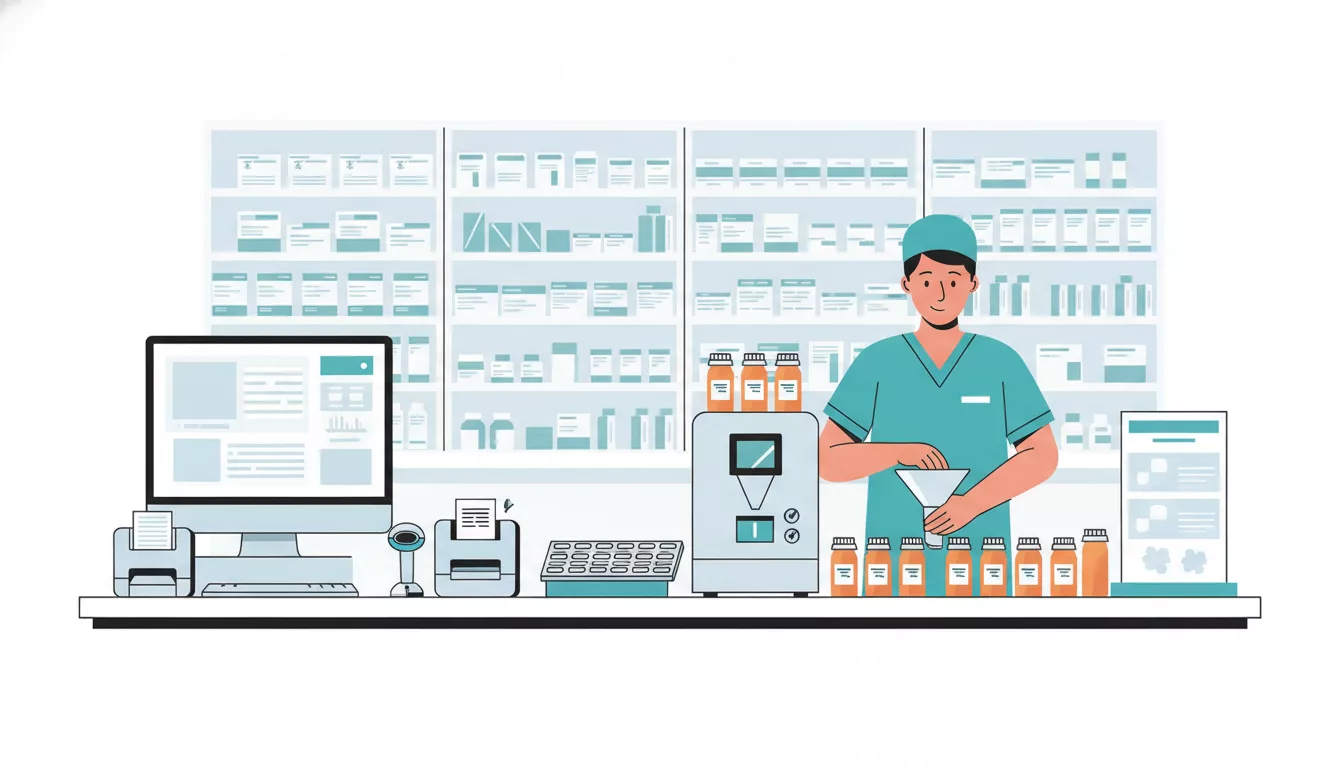
Ask most people what a pharmacy technician does and they will say "counts pills." That is maybe five percent of the job. The rest is data entry, insurance troubleshooting, phone calls with doctors' offices, defusing frustrated customers, and catching the kind of small mistakes that, uncaught, can seriously hurt someone. This is a realistic hour-by-hour look at a full shift for a retail pharmacy technician, plus how the day changes completely if you work in a hospital or a mail-order facility instead. If you are weighing this career, this is the version of it nobody puts in the job posting.
8:00 AM: Opening Before the Gate Goes Up
A retail pharmacy technician usually arrives 15 to 30 minutes before the pharmacy officially opens, and the pharmacist has to be physically present before anything happens because a licensed pharmacist is legally required on site for the pharmacy to operate. You pull up the security gate, boot the computers, turn on the registers, and print the overnight queue. Big chains route refill requests through automated phone and app systems all night, so there is already a stack of prescriptions waiting to be filled before a single customer walks in.
You check the will-call bins for prescriptions that were filled yesterday but never picked up, because after 10 to 14 days those have to be returned to stock and the insurance claim reversed. You look at the day's schedule to see whether you are covering the drop-off window, the drive-thru, data entry, or filling. In a well-staffed store you might have three or four techs splitting those roles. In an understaffed one, which is increasingly common, you might be doing all of them at once while the phone rings nonstop.
8:30 AM: The Voicemail and Fax Backlog
Before the rush, you clear the overnight communications. Doctors' offices fax new prescriptions, and even in 2026 the fax machine is still stubbornly central to pharmacy work. Voicemails pile up from patients asking if their prescription is ready, from nurses calling in changes, and from other pharmacies requesting transfers. Each one has to be handled: a transfer request means you either send or receive the prescription history, verify it, and document it, because controlled substances have strict transfer rules that vary by state and by drug schedule.
This is quiet, unglamorous work, but it sets the tone for the whole day. Every prescription you enter cleanly now is one that will not blow up into a problem at the counter three hours later when the patient is standing there and the line is ten people deep.
9:00 AM: Data Entry and the Insurance Rejection Wall
Data entry is where a huge portion of a pharmacy tech's day actually goes. You type the prescriber, the drug, the strength, the quantity, the directions, and the days' supply into the system, then send the claim to the patient's insurance. Then you wait for the response, and this is where the real job begins, because a large share of claims come back rejected the first time.
The rejection codes are their own language. "Refill too soon" means the insurance will not pay until a certain date. "Prior authorization required" means the doctor has to justify the prescription to the insurer before they will cover it. "Non-formulary" means the plan does not cover that specific drug and you need a therapeutic substitution. "Quantity limit exceeded" means the plan caps how much they will dispense. A skilled technician can read a rejection, understand exactly what the insurer wants, and fix it, whether that means adjusting the days' supply, running a manufacturer coupon, calling the plan, or flagging it for the pharmacist. This single skill is what separates a tech who keeps the line moving from one who creates a logjam.
10:15 AM: Filling, Counting, and the Look-Alike Trap
Now the counting people imagine. You take the stock bottle, verify it against the label three times (the National Drug Code, the drug name, the strength), pour onto the counting tray, count in fives with the spatula, and funnel into the vial. It sounds simple until you understand how many drugs look and sound almost identical. Hydroxyzine and hydralazine. Metformin and metronidazole. Lamictal and Lamisil. These "look-alike, sound-alike" pairs are a documented source of serious medication errors, and the tech is the first line of defense against grabbing the wrong bottle off a shelf where they sit inches apart.
Everything you fill goes to the pharmacist for a final verification check before it can be handed to a patient, because the pharmacist is legally responsible for the accuracy of every prescription. But the pharmacist is checking dozens of prescriptions an hour, so a tech who fills carefully and flags anything that looks off makes the whole safety system work. Rushing here is how people get hurt.
11:30 AM: The Drop-Off Window and the Difficult Conversation
A customer comes to drop off a new prescription and wants it "right now." You explain it will be about 20 to 30 minutes, and sometimes that goes fine and sometimes it does not. People pick up medication when they are sick, in pain, worried about a family member, or stressed about money, and the pharmacy counter absorbs all of that. A patient learns their copay jumped from $10 to $180 because their plan changed formularies in January. Someone finds out their controlled substance cannot be refilled early even though they are going out of town. A parent needs an antibiotic for a feverish kid and the prescription has an error the doctor has to fix first.
Handling these moments with patience is a core, underrated part of the job. You cannot change insurance rules or dispense a controlled substance early, but how you deliver that information determines whether the interaction stays calm or escalates. The techs who last in retail are the ones who can stay steady and kind through the fifteenth frustrated customer of the day without taking it personally.
12:30 PM: Lunch, and Why the Pharmacy Never Really Closes
Many retail pharmacies now close for a 30-minute lunch, a change chains rolled out after years of complaints about techs and pharmacists working eight to twelve hours with no real break. But "closed for lunch" does not mean the work stops. The queue keeps filling from the automated systems, the phone still rings, and you often eat quickly so you can get back to chipping away at the prior authorization pile before the afternoon wave hits.
If you want the honest financial picture of what all this pays by state, setting, and experience level, our pharmacy technician salary guide breaks down real numbers, because the pay reality is a big part of deciding whether this career fits your life.
1:30 PM: The Prior Authorization Marathon
Prior authorizations, or PAs, are one of the most time-consuming parts of modern pharmacy work. When an insurer requires a PA, the prescription cannot be filled until the doctor's office submits paperwork justifying the medication and the insurer approves it. The tech is the middleman, calling or faxing the prescriber's office to start the PA, following up when nothing comes back, and calling the patient to explain the delay.
A single PA can take days to resolve and involve three or four phone calls between the pharmacy, the doctor, and the insurance company. Meanwhile the patient is out of their medication and, understandably, calling the pharmacy to ask what is taking so long. Learning to manage the PA workflow, track which ones are pending, and communicate clearly with everyone involved is a skill that takes months to develop and never fully stops being tedious.
2:45 PM: Immunizations and the Expanding Tech Role
The pharmacy technician role has expanded significantly in the last several years. In a growing number of states, certified techs can now administer immunizations after completing specialized training, something that used to be pharmacist-only. This afternoon you might be drawing up and giving flu shots, COVID boosters, or other vaccines while the pharmacist handles verification and counseling. Even where techs cannot inject, they handle the scheduling, the paperwork, the consent forms, and the state immunization registry documentation.
This expansion is part of why the career has more upward mobility than it used to. Advanced and specialized tech roles (immunization-certified, sterile compounding, medication history, billing specialist) pay more and carry more responsibility. If you are mapping out where this can lead, our complete guide to becoming a pharmacy technician lays out the certification and advancement paths in detail.
3:30 PM: The DUR Flag and Calling the Prescriber
Mid-afternoon, the system throws a drug utilization review (DUR) alert on a prescription you are entering. The software flags a potential interaction between the new drug and something already on the patient's profile, or a dose that looks too high, or a duplicate therapy. Techs do not make the clinical call (that is the pharmacist's job), but you are the one who often catches it first, gathers the information, and gets the pharmacist's attention.
Sometimes it is nothing. Sometimes it means calling the prescriber's office to clarify a dose or flag an interaction the doctor may not have caught, especially when a patient sees multiple specialists who do not share records. This is the part of the job that reminds you why the accuracy obsession matters. You are a real link in a safety chain, and a sharp tech genuinely prevents harm on a regular basis, quietly, without anyone ever knowing it happened.
4:30 PM: Controlled Substances and the Count That Has to Balance
Controlled substances (drugs like opioids, stimulants, and certain sedatives) carry a whole extra layer of rules. Schedule II drugs cannot be refilled at all, require a new prescription every time, and in many cases must be logged in a perpetual inventory where every single tablet is accounted for. You run prescriptions against the state prescription drug monitoring program to catch patterns of misuse. You store these drugs in a secured area, and periodic counts have to balance exactly, because a discrepancy is not a minor bookkeeping issue, it is a potential DEA reporting matter.
Handling controlled substances teaches you fast that pharmacy is a heavily regulated field. A mistake here is not just an inconvenience, it can have legal consequences for the pharmacy and the people working in it. Techs who work with controls develop a genuine respect for the documentation, because the paper trail protects both the patients and themselves.
5:30 PM: Rush Hour and the Drive-Thru
The after-work rush is the hardest stretch of a retail shift. People are getting off work and coming to pick up prescriptions, the drive-thru is backed up three cars deep, the phone is ringing, and the will-call bins are full of pickups that all need to be rung out with insurance verified and, for some drugs, patient counseling offered. You are ringing up a pickup at the register, answering a phone call about a refill, and watching a car idle at the drive-thru all at once.
This is where understaffing hurts the most. When corporate cuts tech hours to control labor costs, the after-work rush becomes a genuinely stressful, sometimes chaotic experience, and it is one of the most common reasons techs burn out and leave retail. Being fast without cutting corners on safety is the daily tension, and it never fully goes away.
6:30 PM: Closing Counts and Handoff
At the end of the shift, you tidy the filling stations, restock what ran low, reconcile the register, and either hand off to the closing crew or shut the pharmacy down. In a 24-hour or late-close store, you brief the next shift on the pending prior authorizations, the problem prescriptions, and the patients who are waiting on callbacks, because continuity matters when a patient calls back at 9 PM about the PA you started at 1:30.
By the time you clock out, you have been on your feet for most of an eight-hour to twelve-hour shift, you have processed well over a hundred prescriptions, fielded dozens of phone calls, and de-escalated a handful of tense counter conversations. Your feet hurt, and the mental fatigue of maintaining accuracy under constant interruption is real.
Retail Is Not the Only Setting: Hospital and Mail-Order Days
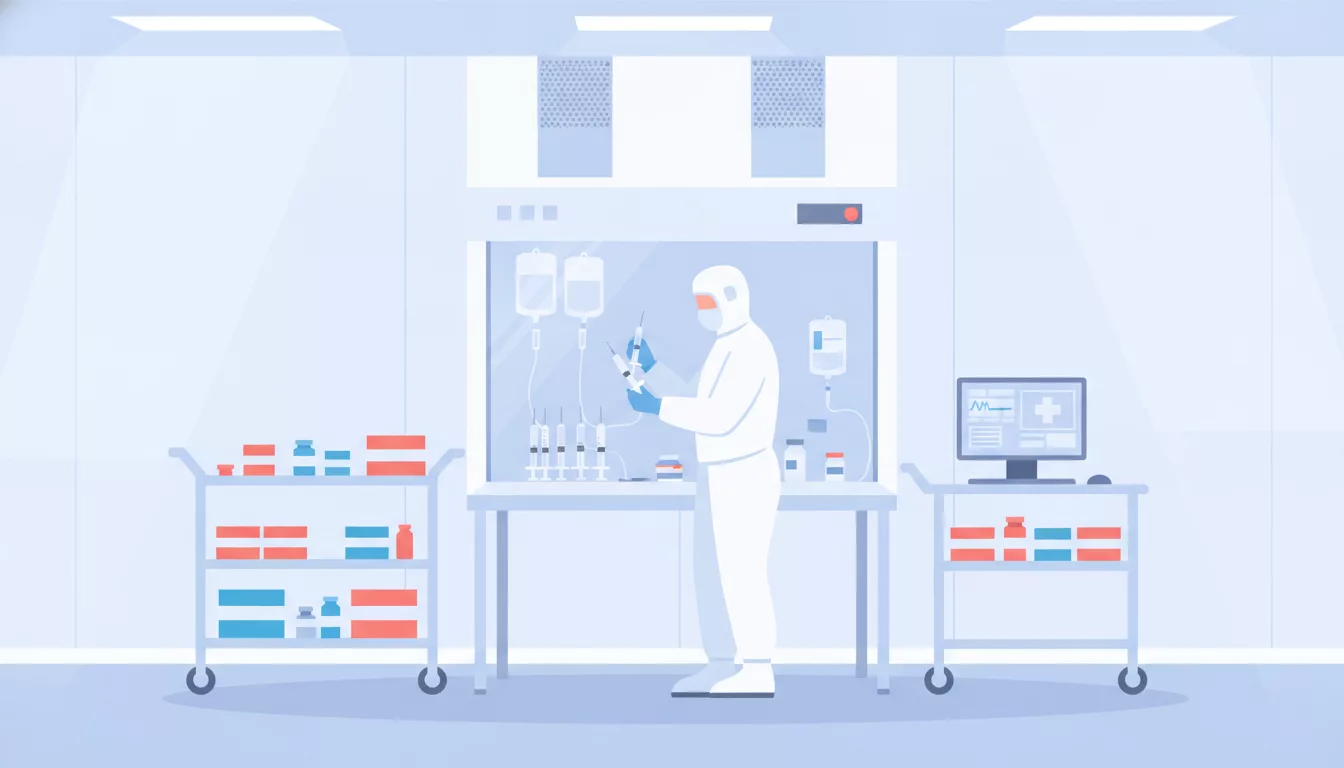
The day described above is retail, where most pharmacy techs work and where most people start. But the job looks completely different in other settings, and understanding the difference is important if you are choosing this career.
Hospital pharmacy techs usually have no retail counter and no insurance battles at all. Instead, the day revolves around filling medication orders for inpatients, stocking automated dispensing cabinets on the nursing floors, and, for those with sterile compounding training, preparing IV medications and chemotherapy in a clean room under a laminar flow hood following strict USP 797 and USP 800 sterile procedures. Hospital work is more clinical, often pays more, usually requires certification, and frequently involves rotating shifts including nights and weekends because a hospital pharmacy never closes. Many techs consider hospital work the more rewarding environment because the pace is steadier and there is no drive-thru.
Mail-order and central-fill pharmacies are a third world entirely. These high-volume facilities fill enormous quantities of prescriptions using automation, robotics, and assembly-line workflows. A tech here might spend the day at a filling station or managing the machines rather than talking to patients at all. The work is more repetitive and less people-facing, which some techs love and others find monotonous. Pay and conditions vary, but the environment is closer to a warehouse or production floor than a retail store.
The certification you carry travels across all three settings, but the daily reality does not. It is worth shadowing or talking to techs in more than one setting before you decide retail is what pharmacy tech work "is," because it is only one version of the job.
The Certification and Registration Reality
Becoming a pharmacy technician is one of the faster paths into healthcare, but the rules depend heavily on your state. Some states let you start working as a trainee and learn on the job. Others require you to register with the state board of pharmacy before you touch a prescription, and some require national certification within a set window after you are hired.
There are two main national certifications. The PTCB certification (which earns you the CPhT, or Certified Pharmacy Technician, credential) is the most widely recognized and often the one hospitals and larger employers specifically require. The ExCPT exam, offered through the National Healthcareer Association, is an accepted alternative that some retail employers recognize, though the CPhT is generally the safer bet if you want maximum flexibility. Both exams cover pharmacy law, medication safety, calculations, and pharmacology, and both require you to pass a proctored test.
Certification is not a one-and-done event. To keep a CPhT active, you complete continuing education (typically 20 hours every two years, including specific hours in pharmacy law and patient safety) and pay a renewal fee. On top of that, most states require their own registration or license, which has its own renewal cycle and fee. Keeping both your national certification and your state registration current is part of the ongoing responsibility of the job, and letting either lapse can stop you from legally working.
What Nobody Tells You About Being a Pharmacy Technician
Insurance is the real job. New techs are always surprised by how little of the day is spent counting pills and how much is spent fighting with insurance companies over rejections, prior authorizations, and formulary rules. If you dislike detailed problem-solving and phone work, retail pharmacy will grind on you.
The pay is modest and the responsibility is real. Pharmacy techs handle medications where a mistake can hurt someone, work under constant time pressure, and are held to strict regulatory standards, yet the pay reflects an entry-level healthcare role more than the weight of the responsibility. Many techs move into hospital, specialized, or supervisory roles specifically to earn more, because base retail pay tends to plateau.
Standing and interruptions wear on you. This is an on-your-feet job for most of the shift, and the mental load of staying accurate while being interrupted by phones, customers, and the drive-thru every few minutes is a specific kind of tiring that is hard to appreciate until you have done it.
Difficult customers come with the counter. People at the pharmacy are often sick, in pain, or stressed about cost, and the tech absorbs that emotion all day. Thick skin and genuine patience are not optional in retail.
It is a genuine stepping stone. A large number of techs use the role as an entry point into healthcare, going on to pharmacy school, nursing, or other clinical careers. Working as a tech gives you real exposure to medications, healthcare systems, and patient interaction that pays off in almost any healthcare path you pursue next.
Is This Career Right for You?
Pharmacy tech work fits people who are detail-oriented, comfortable with repetitive precision, patient with frustrated customers, and steady under time pressure. You need to be careful enough to catch a look-alike drug on a busy day and calm enough to explain a $180 copay to someone having a bad day without losing your composure. If you like problem-solving (and insurance troubleshooting really is problem-solving) and you want into healthcare without years of schooling or heavy debt, it is a practical, accessible entry point.
If you thrive on quiet, uninterrupted work, or you want high pay quickly, retail pharmacy in particular may frustrate you, and you might look harder at hospital or specialized roles from the start. The best way to know is to see it in person. Walk into a busy pharmacy at 5 PM and watch for ten minutes, and talk to a working tech about what the job is actually like day to day.
Ready to take the next step? Prepare with real questions in our pharmacy technician interview questions guide, read the full guide to becoming a pharmacy technician, or start browsing current openings on our job search.