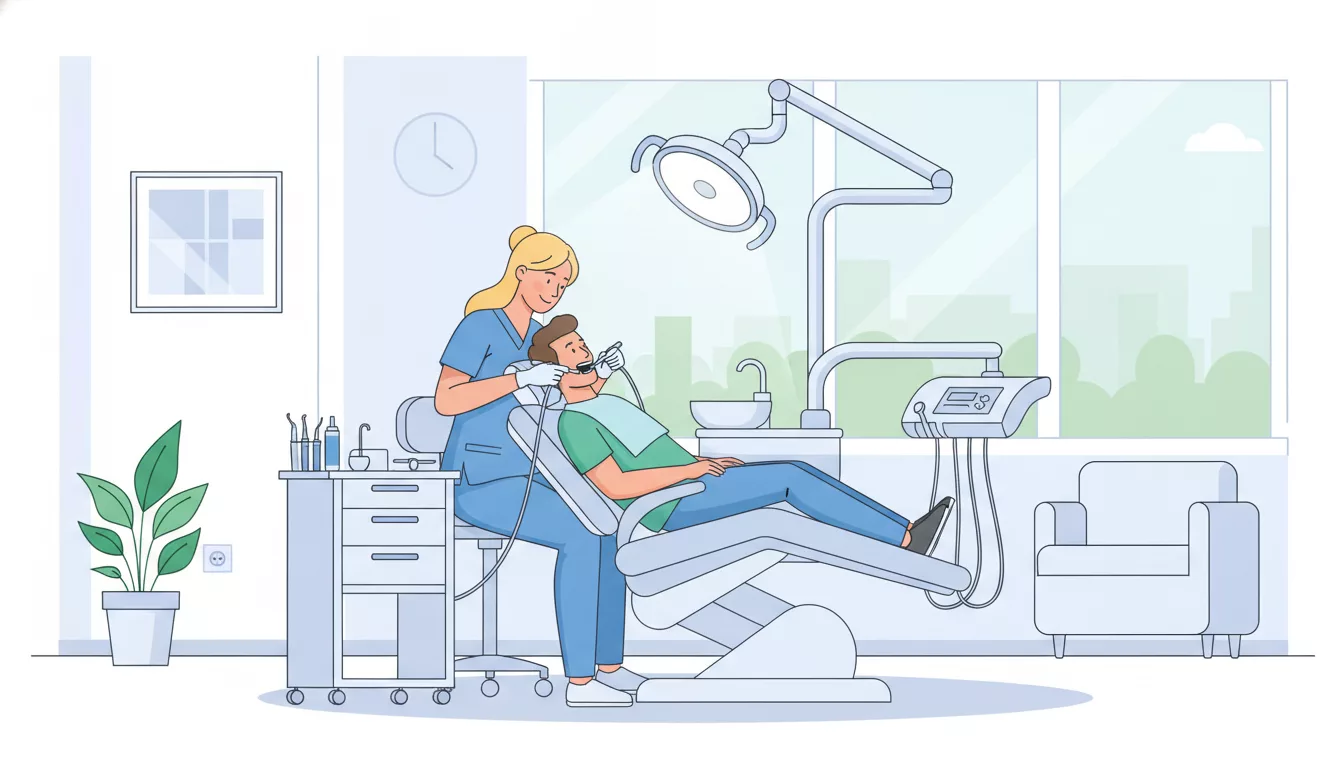
7:00 AM: Sterilization Before Anyone Else Arrives
Most dental hygienists get to the office 30-45 minutes before the first patient. This isn't optional prep time - it's the part of the job patients never see. The autoclave needs a cycle running, instrument cassettes from yesterday's last patients need to come out of sterilization and get organized into today's trays, and each operatory needs to be set up fresh: barriers on the light handles and chair switches, suction lines flushed, the ultrasonic scaler charged and ready.
You check the day's schedule on the way in - who's a routine cleaning, who's a periodontal maintenance patient with deeper pockets that will take longer, who's new and needs a full set of X-rays and a comprehensive charting. A hygienist scheduled for six patients in a day has a very different morning than one scheduled for eight, and the front desk doesn't always leave enough buffer between appointments to account for a patient who talks through their entire cleaning or a child who won't sit still for X-rays.
By 7:15, the coffee's made in the break room, scrubs are on, and you're doing a final walk-through of your assigned operatories. Missing instrument. Empty barrier box. A room that didn't get wiped down properly by the overnight cleaning crew. Better to catch it now than mid-appointment with a patient already in the chair.
7:45 AM: First Patient - The Routine Cleaning That Isn't Routine
Your 8:00 is a 45-year-old man in for his six-month cleaning. On paper this is the most "routine" appointment a hygienist does all day. In practice, no cleaning is actually routine once you're looking inside someone's mouth. You seat him, review his medical history update - any new medications, any health changes since his last visit - and start with a visual exam before you touch a single instrument.
This is where hygienists catch things dentists don't always see first. A white patch on the inside of the cheek that wasn't there six months ago. Bleeding on probing in a spot that was healthy at the last visit. A cracked filling. Recession along the gumline that's accelerating faster than normal wear and tear would explain. You chart all of it - periodontal probing depths at six points per tooth, bleeding indices, plaque scores - because this data is what the dentist reviews before walking in for the exam, and it's what insurance companies use to justify (or deny) treatment.
The actual cleaning takes 30-45 minutes depending on how much calculus has built up. Ultrasonic scaler first to break up the heavier deposits, then hand scaling with curettes to get under the gumline where the ultrasonic tip can't reach precisely enough. Polish, floss, fluoride if it's covered by insurance or the patient wants it. You're doing fine motor work with sharp instruments in a moving, breathing person's mouth for the better part of an hour, and your wrist, thumb, and neck are absorbing repetitive strain the entire time. (Curious what this kind of skilled, physically demanding work actually pays? Our dental hygienist salary guide breaks down real numbers by state and practice setting.)
9:00 AM: X-Rays and the Gag Reflex Problem
Your 9:00 needs a full mouth series of X-rays as part of her new patient exam. Taking dental X-rays sounds simple until you're trying to position a rigid sensor against the back molars of someone with a strong gag reflex. You talk her through breathing techniques, angle the sensor as gently as possible, and take the shot the instant she's steady. Some patients need five attempts to get one usable image. Others gag so severely that you switch to a smaller sensor size or recommend a panoramic X-ray instead, which captures the whole jaw in one image without needing to go as far back in the mouth.
Once the images are captured, you're reviewing them on the monitor before the dentist ever sees them - checking for obvious cavities, bone loss patterns that suggest periodontal disease, impacted wisdom teeth, or anything unusual that needs to be flagged. Hygienists don't diagnose, but you're often the first set of eyes on a problem, and a sharp hygienist catches things that get missed if you're just clicking through images without really looking.
9:45 AM: Periodontal Maintenance - The Harder Cleanings
Not every patient gets a standard cleaning. Patients with a history of periodontal disease come in for periodontal maintenance appointments, which are scheduled every three to four months instead of the standard six and take significantly longer. Your 9:45 has pocket depths of 5-6mm in several areas - deep enough that plaque and bacteria are living below the gumline where a toothbrush and floss can't reach them.
This appointment means deep scaling with local anesthetic sometimes involved, working quadrant by quadrant, and a longer, more uncomfortable conversation about home care. You're not just cleaning teeth - you're doing patient education, explaining why the bleeding is happening, showing proper flossing technique for the fourth visit in a row because habits are hard to change, and documenting everything carefully because periodontal patients are at higher legal and clinical risk if something is missed. These appointments run 60-90 minutes and are physically harder on your hands than a standard cleaning.
11:15 AM: The Anxious Patient
Your 11:15 hasn't been to a dentist in eight years. He's visibly nervous - gripping the armrests, apologizing for his teeth before you've even looked. This part of the job doesn't show up in any procedure code, but it's a huge part of what makes a hygienist good at their job: reading a patient's anxiety and adjusting your entire approach to meet it.
You slow down. You explain every instrument before it goes in his mouth. You give him a hand signal to raise if he needs a break. You skip judgment about the state of his gums entirely and focus on what you can do today to help. By the end of the appointment, he's relaxed enough to laugh at something you said, and he books his next cleaning on the way out instead of avoiding the front desk. That's a win that matters as much as any clinical outcome - a patient who trusts his hygienist is a patient who keeps coming back instead of disappearing for another eight years until something hurts badly enough to force a visit.
12:30 PM: Lunch, Sort Of
Lunch is supposed to be 30-60 minutes depending on the practice, and dental offices are generally better about protecting this time than a lot of healthcare settings because the schedule is built around fixed appointment slots. But it's rarely fully restful. You're eating while charting notes you didn't finish between patients, or the office manager pulls you aside about a scheduling conflict for tomorrow, or a patient calls with a post-appointment question that gets routed to you because you're the one who saw them.
Your hands and forearms are already tired by midday. Hygienists develop repetitive strain injuries at a notably high rate - carpal tunnel, tendinitis, neck and shoulder tension from leaning over patients in awkward positions for hours. Some hygienists do hand stretches during lunch. Others have started using loupes with better ergonomic angles or saddle stools that reduce strain on the lower back. The ones who last 20-30 years in this career are usually the ones who took ergonomics seriously from year one instead of waiting until their hands started hurting.
1:15 PM: A Cavity Nobody Wanted to Find
Your early afternoon patient is a 9-year-old getting her first set of X-rays. Kids' appointments require a completely different skill set - shorter attention spans, genuine fear in some cases, and parents watching from the corner of the room. You use a smaller child-sized sensor, make the whole thing sound like a game, and let her hold the mirror and "help" count her own teeth to keep her engaged.
The X-ray shows an interproximal cavity between two back molars - not visible on a regular exam, but clear on the image. You flag it for the dentist, who confirms it during the exam portion and schedules a filling. Telling a parent their child needs a cavity filled is never a fun conversation, but catching it now, small, means a simple filling instead of a much bigger problem in a year. This is a quiet but real part of the job: dental hygienists find a meaningful percentage of the cavities and periodontal disease that eventually get treated, simply by being thorough and paying attention during appointments other people might rush through.
2:30 PM: Running Behind
By mid-afternoon, the schedule has slipped. The 9:45 periodontal maintenance ran fifteen minutes over. A patient showed up late and you saw them anyway rather than making them reschedule. Now you're trying to make up time without cutting corners on care, which is the daily tension of this job - the schedule wants you to move fast, but the standard of care requires thoroughness, and rushing a cleaning to stay on time is exactly how things get missed.
Most hygienists develop their own system for staying efficient without cutting corners: pre-setting trays during any small gaps, batching documentation instead of writing a full narrative after every single patient, and learning to read a chart fast enough to walk in already knowing the patient's history instead of reviewing it cold in front of them. Efficiency is a skill that takes a year or two to really develop, and it's the difference between a hygienist who finishes the day exhausted but on schedule and one who's perpetually 20 minutes behind and apologizing to every patient in the waiting room.
3:45 PM: The Difficult Conversation
Your 3:45 is a patient in his 60s with advanced periodontal disease - deep pockets, significant bone loss visible on X-ray, several teeth with mobility. This is the conversation nobody enjoys having: explaining that home care and standard cleanings aren't enough anymore, and that he needs a referral to a periodontist for more aggressive treatment, possibly including surgery, to have a real chance at keeping his remaining teeth.
You deliver this information factually but with real empathy, because patients in this position often feel some combination of scared, embarrassed, and defensive. Some get angry at the news. Some cry. Some ask if it's too late, and you have to be honest that early intervention makes a real difference but so does starting today instead of waiting another six months. This is emotionally harder than most of the physical work of the day, and it's a skill dental hygiene programs touch on but can't fully prepare you for. You get better at it with practice, but it never becomes easy.
4:30 PM: Instrument Turnover and Documentation
Between the last two patients of the day, you're sterilizing instruments from earlier appointments, restocking operatories for tomorrow, and catching up on any charting notes that fell behind during the busiest stretch of the afternoon. Every probing depth, every bleeding point, every patient education conversation about flossing or tobacco use needs to be documented - not just for continuity of care, but because incomplete records are a real liability issue if a periodontal condition worsens and the chart doesn't show it was caught and addressed.
You're also prepping the sterilization center for the next day, which means running a final autoclave cycle, restocking barrier supplies, and making sure the instrument cassettes are organized by appointment type so tomorrow's setup goes faster than today's did.
5:15 PM: Last Patient and Closing Down
Your final patient of the day is a returning patient who's easy - healthy gums, good home care, a quick 30-minute cleaning with no complications. These appointments feel like a relief after a day full of harder cases, and you appreciate them more than you did earlier in your career, back when every cleaning felt routine before you understood how much variation exists between patients.
After the last patient leaves, you do a final sterilization run, wipe down operatories, and review tomorrow's schedule one more time so you're not walking in cold. Some offices require end-of-day case notes or insurance documentation to be finished before anyone leaves, which can add 15-30 minutes onto an already long day. By the time you clock out, you've been on your feet or hunched over patients for the better part of eight hours, and your hands, in particular, are done for the day.
What Nobody Tells You About Being a Dental Hygienist
The physical toll is real and cumulative. Hygienists have some of the highest rates of musculoskeletal disorders in healthcare - carpal tunnel syndrome, tendinitis, chronic neck and back pain from years of leaning over patients in fixed positions. This isn't a job you can coast through physically. Investing in ergonomic equipment, proper posture training, and regular stretching from the start of your career matters more than most new hygienists realize.
You are doing real clinical work, not just cleaning teeth. Periodontal charting, X-ray interpretation, patient risk assessment, and early disease detection are core parts of the job. Hygienists frequently catch cavities, oral cancer warning signs, and periodontal disease before a dentist ever walks into the room. The job requires genuine clinical judgment, not just a steady hand with a scaler.
Schedules are tighter than people expect. Most offices book hygienists back to back with 40-60 minute appointment slots, and there's little room for a patient who needs extra time without the whole day slipping. Learning to work efficiently without sacrificing thoroughness is a skill that takes real time to develop, and it's a constant source of stress for newer hygienists.
The pay is genuinely solid for the schooling required. Dental hygiene typically requires an associate degree (2-3 years) rather than a four-year degree, and the median pay is competitive with many bachelor's-required careers. Many hygienists work four days a week rather than five, and part-time or per-diem work is common in the field, offering scheduling flexibility that's rare in healthcare. (See our full salary breakdown for current numbers by state, setting, and experience level.)
Patient relationships build over years, not visits. Because cleanings happen every six months, hygienists often see the same patients for a decade or more. You watch kids grow up, remember which patients hate the taste of mint fluoride, and become a familiar, trusted face in a setting most people find at least a little stressful. That continuity is one of the most rewarding parts of the job that rarely gets mentioned in career descriptions.
Is This Career Right for You?
This work fits people who are detail-oriented, comfortable with close physical proximity to patients for extended periods, and able to stay calm and reassuring with people who are anxious or in pain. You need steady hands and real stamina - not just physical stamina for a full day of fine motor work, but the mental stamina to stay focused through appointment after appointment without letting your attention drift during a routine cleaning that turns out to hide something serious.
The schooling investment is real but shorter than most healthcare careers - typically an accredited associate degree program plus passing national and state board exams. Shadowing a working hygienist before committing to a program is the best way to know if the physical demands and the pace of the work actually suit you, because reading about the job and doing it for a full eight-hour day are very different experiences.
Ready to start your path? Read our complete guide to becoming a dental hygienist, prepare with real interview questions from dentists and office managers, or explore current openings on our job search.