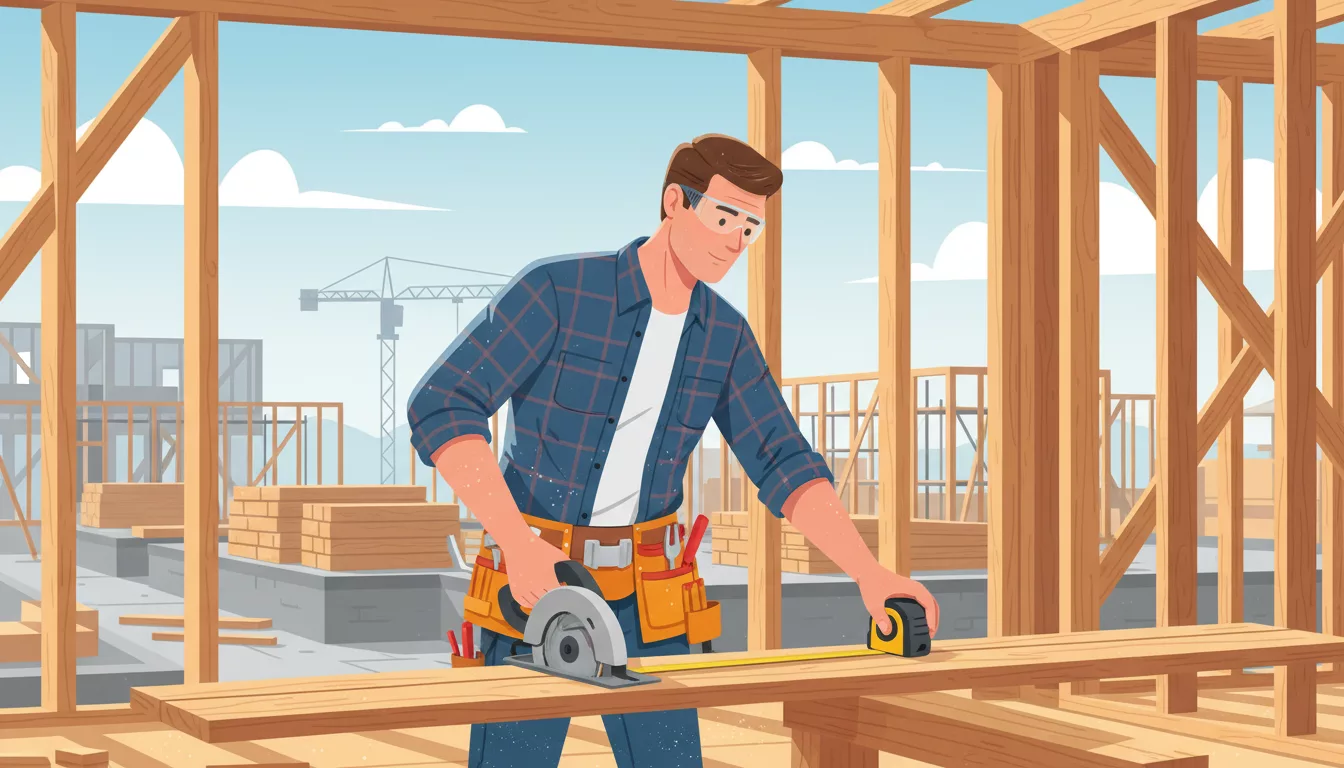
5:45 AM: Before the Sun Hits the Jobsite
Most carpenters are awake before the sun, and not by choice. Residential framing crews typically start at 7 AM, which means you're up by 5:45 to eat something, fill your water jugs, and check that your tools are loaded. If you forgot to charge your impact driver batteries last night, you're going to feel it today.
The morning drive varies. Some carpenters report to a shop first, load materials into a company truck, and caravan to the site. Others drive directly to the build in their own rigs with personal tool trailers. Either way, you're on site by 6:45, walking the area with your crew lead before anyone picks up a hammer. (Curious about the pay? Our carpenter salary guide breaks down what framers, finish carpenters, and cabinet makers actually earn.)
The walk-through matters. Yesterday's work needs checking. Did the concrete guys pour the footings correctly? Are the anchor bolts in the right spots? Is the lumber delivery that was supposed to arrive at 6 AM actually here? Construction is a chain of dependencies, and carpentry sits right in the middle of most of them.
7:00 AM: Layout and First Cuts
The crew lead has the blueprints open on the tailgate. Today's job is framing interior walls on a 2,400-square-foot custom home. The exterior walls went up last week, and the trusses are scheduled for crane delivery on Thursday. Everything between now and then needs to be ready - interior load-bearing walls in place, headers built for doorways and windows, backing installed for the stuff the drywall guys will need to attach things to later.
You start by snapping chalk lines on the subfloor. This is where every wall sits, and if your layout is off by even half an inch on a long run, it compounds. Measure twice isn't a cliche in carpentry - it's survival. You're working from the plans but also checking against the actual slab dimensions, because concrete work is almost never perfectly square. You find that the northwest corner is 3/8" out of square over a 30-foot run. Not terrible, but you note it and adjust your layout to split the difference so no single wall looks visibly off.
Then comes cutting. You're building wall sections flat on the deck - top plate, bottom plate, studs at 16 inches on center, cripples above and below window openings, king studs and jack studs for headers. A framing carpenter can cut and assemble a standard 12-foot wall section in about 15 minutes if everything goes smoothly.
8:30 AM: Standing Walls
With four sections built, it's time to stand them up. This is the part of carpentry that people picture when they imagine the job - a crew of four or five lifting a wall frame off the deck, walking it up, and nailing it into place. It looks dramatic. It is physically demanding. A 16-foot framed wall with a header weighs several hundred pounds, and you're lifting it overhead by hand.
Once the wall is vertical, you brace it with temporary 2x4 diagonals while someone checks plumb with a level. Then you nail the bottom plate into the subfloor and the end studs into the adjoining walls. The crew works in a rhythm - two people cutting, two people assembling, everyone helping stand and brace. A good framing crew barely talks during this phase because everyone knows the sequence.
By 9 AM, you've stood six wall sections and the skeleton of the first floor is starting to look like rooms. This is the part of the job that hooks people on carpentry - you walk onto a bare slab in the morning and by the end of the week, it looks like a house.
9:30 AM: The Header That Doesn't Match the Plans
You're building a header for the main hallway opening when you notice the plans call for a 4x12 header over a 6-foot span, but the beam pocket in the exterior wall was framed for a 4x10. Someone made a mistake somewhere. The structural engineer spec'd a 4x12. The exterior framer built for a 4x10. You can't just use the smaller header - it's a load-bearing wall that carries roof trusses.
This is where experience matters more than muscle. A green carpenter might try to force it or just use what fits. A journeyman stops, calls the general contractor, and flags it. The GC calls the engineer. The engineer confirms the 4x12 is required and says the beam pocket needs to be reframed to accept it. That's a two-hour fix for the exterior crew, and it pushes your interior schedule back.
Construction is full of these moments. Plans conflict with reality. One trade's work doesn't align with another's. The carpenter who can read prints, spot problems early, and communicate clearly is worth twice as much as the one who just swings a hammer. (These problem-solving scenarios come up in job interviews too - see our carpentry interview questions guide for what foremen actually ask.)
10:15 AM: Break and the Apprentice Question
Morning break is 15 minutes. The crew sits on stacked lumber, drinks water (or coffee, even in July), and somebody's always eating gas station breakfast burritos. The apprentice on the crew asks about getting into finish carpentry. He's been framing for eight months and thinks trim work sounds easier.
The crew lead laughs. Finish carpentry is a completely different skill set. Framing is about speed, strength, and structural accuracy to within a quarter inch. Finish carpentry is about precision to within 1/32 of an inch, patience, and an eye for aesthetics. Crown molding that doesn't meet cleanly in corners, baseboards with visible gaps, cabinet faces that aren't perfectly level - those are the things homeowners actually see and judge. A framer can hide mistakes behind drywall. A finish carpenter's work is on permanent display.
Most carpenters start in framing and move toward finish work as their skills develop. Some prefer to stay in framing because the pace is faster and the work is more physical, which suits their temperament. Others go into cabinet making, which is essentially furniture building at an architectural scale. (If you're considering the career path, our guide to becoming a carpenter maps out the full journey from apprentice to journeyman.)
10:30 AM: Backing, Blocking, and the Stuff Nobody Sees
After break, you switch to backing and blocking - the hidden wood pieces inside walls that give other trades something to attach to. The plumber needs backing behind the shower valve. The electrician needs blocking for the panel. The cabinet installer needs solid wood at specific heights for upper cabinet mounting. The TV mount guy needs a 2x6 horizontal block between studs at 54 inches off the floor.
This is invisible work. When the house is finished, nobody will know this blocking exists. But without it, shower valves pull out of walls, cabinets fall, and TV mounts rip through drywall. Carpenters install dozens of these backing pieces in a typical house, all at precise heights and locations specified on a backing plan or communicated verbally by the GC.
It's tedious compared to standing walls. But it's the kind of detail work that separates professional carpentry from amateur remodeling. When a finish carpenter shows up months later and every single blocking piece is exactly where it needs to be, they know a good framer was here.
12:00 PM: Lunch
Lunch is 30 minutes. Some crews eat on site. Some drive to the nearest fast food place. The experienced guys bring coolers because buying lunch every day at $12-15 adds up to $250 a month - a fact the apprentices learn the hard way.
Lunch conversation on a construction site covers a predictable rotation: whose truck is falling apart, which local contractor pays the best, someone's side job that went sideways, and whatever game was on last night. There's also shop talk - how to solve a specific framing problem, which nail gun is worth buying, whether the lumber quality this year is worse than last year (the consensus is always yes).
The physical reality of lunch is worth mentioning. You're eating with hands that have been gripping tools for five hours. In winter, your fingers are stiff. In summer, you're covered in sawdust and sweat. There's no break room, no sink, no microwave. You sit on whatever flat surface is available and make it work.
12:30 PM: Afternoon Grind - Bathroom and Closet Framing
The afternoon starts with the detailed work - bathroom walls, closet framing, and specialty areas like the pantry and laundry room. These are smaller spaces with more complexity per square foot than the big open rooms you framed this morning.
Bathrooms require extra attention. The walls around tub/shower enclosures need to be precisely square and plumb because tile work is unforgiving. If a bathroom wall is out of plumb by 1/4 inch over its height, the tile installer is going to have a noticeable taper at the top of the shower. That gets flagged, the GC gets angry, and someone has to fix it. Easier to get it right now.
You also frame soffits for bathroom vent fans, build out medicine cabinet recesses between studs, and install horizontal backing for grab bars and towel racks. A master bathroom in a custom home can take a two-person crew most of the afternoon just for the framing.
Closets are simpler but still require planning. Walk-in closets get framed with the shelf and rod heights already marked for the trim carpenter. Reach-in closets need headers above the openings. You're also leaving gaps for HVAC ductwork runs that will snake through interior walls - the mechanical plan shows where the registers land, and you frame around them.
2:30 PM: The Weather Check
Carpentry is outdoor work, at least during the framing phase. In 2026, extreme weather events are more frequent, and every crew lead watches forecasts like a farmer watches rain. Today's radar shows thunderstorms rolling in around 4 PM. That changes your priorities.
The trusses coming Thursday can't sit on walls that got rained on without protection. You spend 30 minutes tarping the top plates and any stored lumber that isn't under cover. Wet lumber warps. Wet subfloor swells and needs to dry before flooring goes down. Wet framing connections lose holding power until they dry. None of this is catastrophic, but it all slows the job down and costs money.
Weather delays are the invisible cost of outdoor construction. In northern states, carpenters might lose 30-40 working days per year to weather. In the South, summer afternoon storms are daily interruptions from June through September. You learn to front-load your critical work in the morning when conditions are predictable.
3:00 PM: Clean-Up and Material Check
The last hour of the day isn't just working until the whistle blows. A professional framing crew spends the final 30-45 minutes cleaning the site and prepping for tomorrow. Cut-offs go in the scrap pile. Nails get swept up (stepped-on nails are the most common jobsite injury in carpentry). Tools get collected and secured. The compressor gets drained and the hoses coiled.
You also do a material check. You ran through more 2x4 studs than estimated today because of the bathroom framing complexity. You need another unit of studs delivered, plus LVL material for a beam that's going in tomorrow. The crew lead calls the lumber yard before they close and schedules a morning delivery.
Then you walk the day's work. You check that every wall is plumb, every corner is square, every nail is driven flush. If the building inspector shows up tomorrow, you want zero corrections. Failed inspections mean rework, which means lost time, which means lost money. A good framing crew passes inspections on the first try because they built to code all along, not because they crammed fixes in the night before.
3:45 PM: Loading Out
By 3:45, tools are in the truck and the site is clean. The drive home is when the physical toll becomes real. Your shoulders ache from overhead nailing. Your knees complain from kneeling on subfloor all day. Your hands have that deep fatigue from gripping a framing nailer for eight hours. In summer, you're dehydrated despite drinking a gallon of water. In winter, your lower back is stiff from working in cold muscles.
Carpentry is physically demanding work that takes a cumulative toll. Most carpenters in their 40s and 50s have some combination of joint problems, hearing loss (nail guns are loud), and back issues. The trade is getting better about safety - hearing protection, knee pads, and ergonomic tool design are more common now than they were 20 years ago. But it's still a job that wears on your body in ways that office work never will.
The upside? You built something today. Not metaphorically - literally. You walked onto a bare slab this morning and left behind the skeleton of someone's home. By Thursday, when the trusses go on, it'll look like a real house. There's a satisfaction in that tangibility that no amount of spreadsheet work can match.
After Hours: The Side Hustle and Continuing Education
Many carpenters run side jobs in the evenings or on weekends. A deck build here, a fence there, maybe finishing a basement for a friend of a friend. Side work is where carpenters make extra income and build the client base that eventually lets some of them start their own contracting businesses.
There's also the learning curve that never really ends. Building codes change every three years when new ICC editions are adopted. Material science evolves - engineered lumber products, new fastener systems, advanced framing techniques that use less wood. A carpenter who stopped learning in 2015 is already behind on current energy code requirements, seismic bracing standards, and fire-blocking details.
Union carpenters get structured continuing education through their locals. Non-union carpenters pick it up through manufacturer training, code seminars, and on-the-job mentoring. Either way, the carpenters who invest in their knowledge earn more and get the better jobs. A foreman position - running crews and reading complex commercial plans - typically requires both years of field experience and a solid understanding of structural engineering principles.
What Nobody Tells You About Carpentry
The Instagram version of carpentry is satisfying time-lapses of timber frames going up and perfect dovetail joints being assembled. The real version includes these parts that rarely make the feed:
- Lumber quality is inconsistent. You'll spend 20 minutes sorting through a unit of studs to find straight ones because half the delivery is crowned, twisted, or has bark edges.
- Porta-potties are your bathroom. For months at a time on new construction. No running water on site during framing.
- You work in every weather condition. Not just rain delays - you work in 20-degree cold, 100-degree heat, wind that tries to rip sheathing off before you nail it, and mud that turns the jobsite into a swamp.
- Injuries are common. Cuts, splinters, smashed fingers, dropped materials landing on feet, falls from scaffolding or roof edges. Safety culture has improved massively, but carpentry remains one of the higher-injury trades.
- Math is constant. Not calculus, but fractions, geometry, and spatial reasoning all day long. Roof angles, stair calculations, material estimates - if you can't do math in your head while standing on a ladder, the job is going to be frustrating.
- The money is real. Experienced carpenters, especially in commercial work or specialized niches like timber framing, can earn very solid middle-class incomes. But the first few years as an apprentice can be lean.
Is Carpentry Right For You?
If you like working with your hands, solving spatial problems, and seeing physical results from your labor every single day - carpentry is one of the most rewarding trades you can enter. It's not easy. It's not glamorous. But it builds real things that shelter real people, and there's a deep professional pride in that.
The demand isn't slowing down either. Housing construction, commercial building, renovation work, and specialty projects all need skilled carpenters. The Bureau of Labor Statistics projects steady growth through the decade, and the retirement wave hitting the trades means experienced carpenters are increasingly hard to find and increasingly well-paid.
You don't need a four-year degree. You need a willingness to learn, physical endurance, and enough patience to measure twice when everything in you wants to just cut the board. Start as an apprentice, find a mentor who builds well and teaches willingly, and give it two years before you decide if it's your career. Most people who make it past year two never leave.